
'whom he believes in ... or whom he has faith in. But we don't know whether that person will be competent or not. This will lead to a lot of uncertainty in the minds of investors and shareholders of the Tata group companies.'

Repeated increases in new luxury-car prices, driven partly by the rupee's depreciation against the euro, are expanding the market for certified pre-owned vehicles.

India Inc's first-quarter earnings season was significantly impacted by the West Asia conflict, leading to rising costs, calibrated price increases, and margin pressures across various sectors including FMCG, automotive, steel, and cement. Companies are implementing price hikes to protect profitability, with many anticipating further escalations if input costs remain elevated.

With passenger vehicles (PVs), two-wheelers and three-wheelers registering double-digit growth, manufacturers raise production as the industry enters the festival season.

Chandrasekaran's exit is more than a change of chairman. It represents the breakdown of the informal consensus that governed the Tata system under Ratan Tata.

Indian pharmaceutical companies are not rushing to relocate manufacturing to the United States despite former President Donald Trump's renewed threat of tariffs up to 200 per cent on imported generic drugs. Instead, they are leveraging existing US plants, contract manufacturers, and making selective investments in complex products while maintaining India as their primary production hub.

The refreshed Brezza will target first-time, replacement and additional-car buyers as Maruti responds to changing preferences and intensifying competition in compact SUVs.
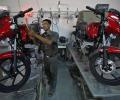
Bajaj Auto plans to increase its annual production capacity by nearly 25 per cent, from around 7 million to over 9 million vehicles, in the coming quarters. This expansion is driven by strong export demand and rapid growth in electric vehicles, which have stretched current capacity across key product segments.

JSW MG Motor India has unveiled ADAPT, India's first multi-powertrain new energy vehicle (NEV) platform, designed to support electric, hybrid, plug-in hybrid, and range-extender electric vehicles. The company plans to launch one electric SUV and one plug-in hybrid SUV based on this architecture during FY27, aiming to broaden its NEV portfolio and accelerate adoption in India.

India's electric two-wheeler (e2W) market is consolidating, with established manufacturers TVS Motor, Bajaj Auto, and Hero MotoCorp, alongside EV specialist Ather Energy, driving nearly 96% of incremental registrations in the first half of 2026, while former market leader Ola Electric experienced a significant decline in registrations.

Tata Motors expands its market leadership in India's electric passenger vehicle (ePV) segment, capturing 39 per cent of the market in Q1FY27, while simultaneously strengthening its position as the nation's second-largest carmaker amidst fierce competition and rapid market growth.

The Delhi government has approved the Delhi EV Policy 2.0, which will phase out fresh registrations of internal combustion engine (ICE) two-wheelers and three-wheelers over the next two years, starting with a ban on ICE 3Ws and N1 category LCVs from January 1, 2027, and ICE 2Ws from April 1, 2028.

Tata Motors' commercial vehicle (CV) business is strategically repositioning itself from a traditional truck manufacturer to a comprehensive logistics and mobility platform, aiming to reduce dependence on cyclical vehicle demand by accelerating growth in digital, international, and services segments.

The launch highlights the growing maturity of India's nuclear medicine ecosystem.

Mercedes-Benz India is exploring a larger role for plug-in hybrid electric vehicles (PHEVs) in its portfolio, with plans to potentially introduce the technology in more models beyond the newly launched S-Class plug-in hybrid. This strategy aims to cater to luxury car buyers who are hesitant about fully electric vehicles due to concerns over charging infrastructure and range.

Mahindra & Mahindra (M&M) is expanding its farm equipment strategy beyond tractors to include a wider range of mechanisation solutions like harvesters, balers, seed drills, and telematics-enabled services, aiming to capitalise on the growing demand for rental services by rural entrepreneurs and address low mechanisation levels in Indian agriculture.

'When I look at India's relative valuations, these are by far the lowest I have seen in my 35-year career.' 'The relative 12-month trailing performance is among the weakest I have seen, and foreign investor positioning is at a 16-17 year low.'

The unprecedented rally in artificial intelligence (AI)-linked stocks has led to Indian companies being excluded from the top 10 constituents of the MSCI Emerging Markets (EM) Index for the first time in over two decades, raising concerns about concentration risk.

Companies are already diversifying sourcing, raising prices, and reworking operating models as the disruption drags on.

Tata Motors' commercial vehicle business is increasingly focusing on parts, services, connected-vehicle platforms, and digital businesses to drive growth and reduce dependence on cyclical vehicle sales, as outlined in its FY26 annual report.
